The spirit of judo. I think the spirit of judo and
the spirit of the Japanese are similar. They are connected.
(SINCE THE OLYMPIC GAMES TOKYO 1964 WHEN JUDO MADE ITS
(OLYMPIC DEBUT, JAPANESE JUDOKA HAVE WON 39 GOLD MEDALS.
(FRANCE, ITS NEAREST RIVAL, HAS WON 14)
(39 GOLD
(19 SILVER
(20 BRONZE)
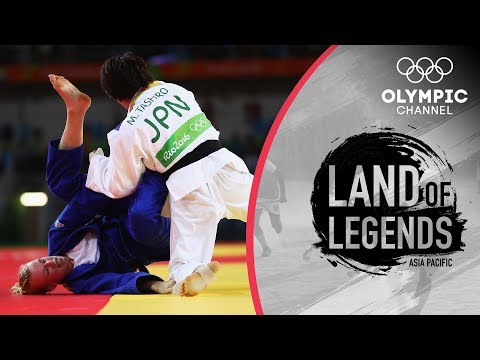
(LAND OF LEGENDS ASIA PACIFIC)
It's all about beauty.
If you try to argue which country is better than which,
you will see that there are a lot of
judoka around the world that win by ippon
and just a lot of really good judoka out there in general.
But what I think sets us apart
is the beauty of Japanese judo matches.
I say this because we place a lot of
importance on basics from a very young age.
We practise the basics dozens of times, hundreds of times.
But not only just practise it, we practise
to get it more beautiful and effective.
It becomes ingrained in our bodies.
So when something happens in a match,
my body can naturally react without me having to think.
So I would say that the link between judo,
kabuki,
tea ceremony,
calligraphy
is the Japanese way of teaching,
which is this method of replication.
And you basically watch the teacher do the motion
and then you replicate the motion.
And you do this again and again and again.
This is why I think the Japanese are so good at judo
and have been, even though judo has become internationalised.
It's because they will practise uchi-komi,
which is basically fitting in and practising the throws
a hundred times, a thousand times, ten thousand times.
From the age of six years old to the age of 16,
how many thousands of repetitions?
And this is how you perfect your technique in judo.
And in the other arts, whether they're the
fine arts or tea, it's the same idea
of repetition to perfection.
The difference between Japanese judo training
and other countries' training styles
is probably first and foremost
the amount of time spent training.
Last year, I went on a short judo exchange trip to Slovenia.
They were different
in that they practised a lot of different things
in very short periods of time.
They practise a lot, but it is short training.
In Japan, we practise for long periods
and the amount of training we do is a lot more.
This is the biggest difference.
I think the strengths of the Japanese is our
ability to continuously do repetitions.
We do the same technique repeatedly
because it's very important to do so.
Our parents were quite strict when they were raising us.
It was very tough, with long hours of training.
But it taught us about endurance and perseverance.
I think there are strengths
that can only be found in Japanese judoka.
Whenever I fight against overseas competitors,
I notice things like their differences
in power and their reach.
For example, Chinese judoka are extremely strong
and Korean judoka are very fast.
And I realised that because Japanese are also Asian,
that we can also be just as strong and just as speedy.
And then, when you compare us to European judoka,
I realised that Japanese judoka have been
learning judo from a very young age.
Inside that power, there is softness.
I also feel that the way we move our centre of gravity
is a lot more delicate when compared with others.
So the strength of the Japanese is that
we are able to utilise and make use of these points.
In 2013, I went to Sao Paulo in Brazil to study.
Compared to Japan, the Brazilians trained
intensely for very short periods of time.
They would then rest for two minutes
and then go at it intensely again.
There was a lot of this kind of training.
The Brazilians' explosive power is incredible,
and the physical ability they possess is amazing.
For Japanese, it is more of a case of being persistent
rather than trying to develop explosive power.
Patience, endurance and stamina are our strengths.
That's the big difference for me.
I think for the Japanese in terms of the Olympics,
judo is really important because, first thing,
it really represents the Japanese culturally.
And then, when you look at the medal haul,
you realise that they've had great success.
Now you do have Olympics where the
Japanese had really bad results.
One of them would be London,
where they only won one gold medal.
And there was some consternation.
"Has judo changed?
"Why did we not win more medals?"
And so it really gets to the heart of the Japanese identity
if they can't pull a lot of medals in judo.
Make no mistake about it, the level of
world judo right now is extremely high.
It is much harder for Japanese to win a gold now
than when I was an Olympic athlete.
For us Japanese, the lack of
medals at the 2012 London Olympics
should never have happened.
It was the first time a Japanese male
judoka failed to get gold at the Olympics.
So, having said that,
we decided to start trying new things.
We started over from scratch, rethinking everything.
Tackling one thing at a time, we were hell-bent
on fixing everything and learning from our mistakes.
For example, when we looked at new methods of training,
we analysed other countries and their techniques,
and also how they train.
We took what we thought was useful and
incorporated it into our training.
For example, Russian people have a sambo backbone,
so we studied this a little.
We stopped thinking that, because judo is Japanese,
we don't need to learn other things.
One by one, we would like to put these
things into our Japanese judo culture.
This is one example of what we did after London.
It has been a long time since Japan hosted the Olympics.
The Japanese people have high expectations.
We take pride in the fact that judo is Japanese
and we will put this on the line.
We will show people the model which to aim for.
In doing this, we are sure to produce good performances
and, in turn, show the beauty of judo.
If we are able to show high quality techniques,
it won't matter if you are an amateur or a professional,
the beauty of judo will surely touch your heart.
I had quite a disappointing Rio Olympics,
quite a feeling of regret.
So the 2020 Olympics is the stage for me
to forget my poor 2016 Olympic showing.
The next Olympics is being held
in Tokyo and this makes me happy.
I will definitely win the gold medal in Tokyo.
We have to show the world that we are the best at judo.
At the 2020 Olympics, I want to stand up and be recognised,
and let everyone know who Hifumi Abe is.
by dominating and winning gold.
We know we are not untouchable any more.
We need to evolve and progress.
I know we will.
(LAND OF LEGENDS ASIA PACIFIC)


 For more infomation >> Cleanup starts in Land O' Lakes - Duration: 1:29.
  For more infomation >> Alter Betrieb - neues Konzept: "Schwarzhubers Chickeria" | Unser Land | BR Fernsehen - Duration: 12:09.


 For more infomation >> Alternative für Landwirte: Wild aus dem Gehege | Unser Land | BR Fernsehen - Duration: 5:28.

 For more infomation >> Hopeless Land Vs Pubg...!!! - Duration: 19:44.


Không có nhận xét nào:
Đăng nhận xét