^ Subscribe to these channels ^
Clash of Clans | TH10 Farming Base 2017 | TESTED IN CHAMPION LEAGUE! | BEST Town Hall 10 Hybrid Base

Đăng ký:
Đăng Nhận xét (Atom)
-------------------------------------------
Best Hip Hop Workout Music Mix 2017 – Svet Fit Music - Duration: 37:51.
Svet Fit Music
-------------------------------------------
Best of Reliance JIO TV ADS | TVC Episode 21 - Duration: 5:29.
Best of Reliance JIO TV ADS | TVC Episode 21
Best of Reliance JIO TV ADS | TVC Episode 21
Best of Reliance JIO TV ADS | TVC Episode 21
-------------------------------------------
French Music in French Cafe: Best of French Cafe Music (Modern French Cafe Music Jazz & Jazz Music) - Duration: 3:42:27.
For you and your enjoyment: French Music in French Cafe: Best of French Cafe Music (Modern French Cafe Music Jazz & Jazz Music)
-------------------------------------------
Bad News: Dr. Pepper Isn't The Best Gift Giver - Duration: 1:00.
You think you put some pep in her step, but she put some cavity in her tooth.
That's what she did.
Dr. Pepper surprised a student with a giant fountain of soda.
Which shouts fun, but I'm like, couldn't they have paid for her college?
Whaa... why?
What's with these social media gimmicks?
I can't.
Also, when you're in college, living with roommates, is tough.
Can you imagine having a roommate, who just has a fountain of soda?
You're like, "Jessica, that's where I keep my computer.
Jessica, your fountain of soda is blocking the television."
Like after a week, she's... guys are gonna come over, what, like she's going to be hooking
up with a guy and he comes over and he's like, "Let me just move..."
"Move my fountain of soda."
Come on!
And I love Dr. Pepper.
And this hurts.
This pains me.
At first, it's gonna be cool, "Look, anyone want free soda?"
But then she's gonna be like, "I don't wanna be known for the free soda.
Like, that's not...
I'm literally working on my masters thesis.
I don't want to be known for free soda.
Dumb story!
Dumb bad story, Dr. Pepper.
And I love you.
Dumb bad story.
Sorry not sorry.
-------------------------------------------
New Best Nail Designs Manicure New 2017. Elegant Business Woman. Compilation 2017 - Duration: 9:51. For more infomation >> New Best Nail Designs Manicure New 2017. Elegant Business Woman. Compilation 2017 - Duration: 9:51.
 -------------------------------------------
PLAYERUNKNOWN'S BATTLEGROUNDS: THE BEST WINNING STRAT! [ENG SUB] - Duration: 3:12.
Cmon guys, go with me!
Thug lifers Bro!
Bullet, don't loot and go!
Lets go! When u see someone, just drive over him!
Or we can just go out in the zone, but they'll know it
Just drive, just drive!
Fu*king di*khead jesus christ :D
He's here, right side!
I'll keep driving, i have no gun to play with
Go, go, just keep driving! The car is your gun now!
Hes somewhere here next to us I think:D
Be our lawn-mower !:D
Thats how the rats feel :D cmon
hey, its 3vs1 clutch now!
Yes... oh thats true!
just drive it Bullet!:D
I dont see him boys!
You have to drive in circles around us!!:D
Biggest thug life ever!
Just imagine his view :D:D:D
but this loot again
, we had totally nothing !:D
-------------------------------------------
Why Don Quixote is the Best Work of Fiction According to 100 Authors - Duration: 57:42.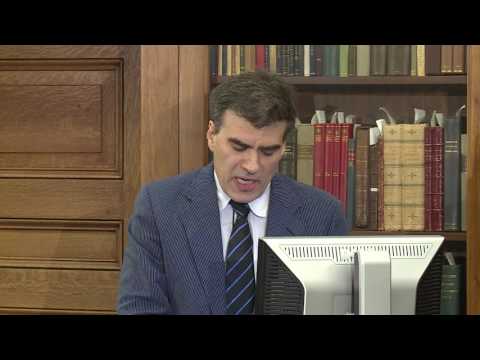
>> From the Library of Congress in Washington, D.C.
>> Talia Guzman-Gonzales: On behalf of the Hispanic division I would
like to welcome everyone to this beautiful room.
It's quite a treat for me to be here
so I hope you appreciate that as well.
This is the Rosenwald Room of the Rare Book
and Special Collection Division
who also helped us collect this wonderful display that we're going
to be talking about after the talk.
As you know this year we celebrate the 400 anniversary of the death
of Miguel de Cervantes Saavedra, the author of "Don Quixote",
first novel reaching the modern world and published in 1605
and today you get to see one of those 1605 editions so it's--
>> Oh my.
>> Talia Guzman-Gonzales: pretty exciting.
The Library of Congress has an unparalleled collection of editions
of "Don Quixote" and other miscellany including two definitive
editions, one pirated in Portugal
and another published by the author in Spain.
The library also has the translations--
all the translations
to "Don Quixote" including a beautifully illustrated edition
in [inaudible] that we couldn't bring today
but we have another event on "Don Quixote" in December
and we'll have that then.
Researchers who would like to learn more about our collection can start
by [inaudible] book where we, it's a collection of the books of,
by Miguel de Cervantes in the Library of Congress.
So today we have the pleasure
of welcoming Professor Hernan Sanchez Martinez de Pinillos
from the Department of Spanish Portuguese
at the University of Maryland.
>> Whoo!
>> Talia Guzman-Gonzales: [Laughs] Professor de Pinillos holds a
Bachelors and a PhD in Medieval Literature with Honors
for the Best Dissertation in Spanish Philology
at the Universidad Complutense.
He has a Masters in Philosophy and a PhD in Spanish Golden Age Literature
from Columbia University in New York.
He is corresponding member for the Spanish Royal Academy of History
since 2012 and a Member Collaborator
of Cilengua Centro Internactional de Investigacion de la Lengua Espanola.
He has published a scholarly edition and study
of a 15th century manuscript and numerous articles
in prestigious journals on major works of Spanish
and Latin American Literature including Cervantes,
Lope de Vega and Quevedo.
Currently he's working, or he's reviewing a publication of the books
"La poesia del pensamiento Quevedo y la tradicion occidental",
and "Cervantes and Edgar Allen Poe in Counterpoint".
After Professor de Pinillos' talk we're going to have my colleague
from the Hispanic Division Juan Manuel Perez is going to be talking
about some of the rare editions that we have here
at the Library of Congress.
So I hope you'll stay for that as well.
So welcome, Hernan.
>> Hernan Pinillos: Thank you very much all of you for being here today
on a rainy Friday afternoon.
Thank you very much Dr. Georgette Dorn from the Hispanic Division
and thank you Talia and thank you [talking in foreign language] from--
[ Inaudible ]
>> Hernan Pinillos: That was?
Okay. Yeah I was thanking Dr. Georgette Dorn for the opportunity
to commemorate Cervantes' anniversary--
the anniversary of his death and Talia and the head
of the Hispanic department also for well, yeah, contributing to this,
the possibility of this event.
I'm going to be talking a bit about the invention
of the character Don Quixote, how the novel presents this character
and the construction of the novel and then the projection
of "Don Quixote" throughout the ages in different context.
In the opening chapter of Cervantes'
"Don Quixote" we meet a middle aged small town bachelor whose life is
defined by its monotony and invisibility.
He lives with his young niece and with a housekeeper.
He has but two friends.
His name is Alonso Quijano or Quijada.
Alonso has no productive activity to occupy his fertile imagination.
As we are informed of the dull details
of a poor hidalgo's everyday life we learn
that his only distinctive feature is that he devotes all his time,
day and night, to the task of absorbing books of chivalry
to the point of obsession.
Ignoring their [inaudible] distinction between history
and poetry, Alonso Quijano loses himself in books of fiction he deems
to be histories of facts.
In the madness of reading fictional literature as history,
Alonso Quijano begins to imagine the script for his own life.
And at this point something remarkable occurs.
Quijano begins moving out of himself as he formulates a new life project
in the form of a real character of his own invention.
We as readers are present as Alonso Quijano reinvents himself.
The character invented by the author is presented to the reader
in his intimate process of transformation and self invention.
A main character invented by Cervantes,
Alonso Quijano recreates himself as the knight Don Quixote.
By naming himself-- it takes a week to think of his name, Don Quixote--
Alonso Quijano literally wills himself into a new existence.
In a sort of reproduction of the baptismal sacrament,
an outer baptism of sorts as some critics have termed it,
Alonso Quijano's madness and conversion are here inseparable.
Madness is conversion and conversion is madness.
We can recall all the famous religious conversions of the past.
St. Paul, St. Augustine, St. Francis.
But even more relevant are Ignatius of Loyola and Santa Teresa
who are great readers of chivalry novels.
Ignatius of Loyola read romances of chivalry while convalescing
from a wound, and the religious order he created,
the Jesuit Society, was to be a sort of spiritual knighthood.
So you see the parallels.
The stated cause of Alonso Quijano's conversion is reading,
but the underlining causes have been described differently by critics.
Midlife crisis.
Boredom. Love.
Fear of old age.
The will to leave behind an empty and meaningless existence.
And thus the knight Don Quijano, the hero of a tale
of chivalry is being born.
From now on his life will be an imitation of art and an attempt
in transforming life into art.
Ortega said, whose philosophical system was born as a commentary
of "Don Quixote" in 1914 in the book "Meditaciones del Quijote" wrote
in 1935 in [inaudible] that whether he be original or a plagiarist man--
man or and women-- or women, are the novelist of him or herself.
Women and men are continually rewriting themselves
after becoming dissatisfied with older versions,
with their older versions and then revising their previous selves
into someone new.
Bored of being the invisible man Alonso Quijano,
the ostracized non-entity Alonso Quijano the great reader
of novels will die to be reborn as the author of his own story,
the novelist of his own existence.
A life titled "The Ingenious Hidalgo Don Quixote de la Mancha" [talking
in foreign language], a title that is both absurd and subversive.
The adjective ingenious doesn't usually qualify the noun hidalgo,
a social category of lower nobility whose distinctive mark like that
of all nobility would be courage.
In the medical treatises of the times, men of high wit,
[talking in foreign language] were described
as having a precarious psychological balance.
[Talking in foreign language] was typically accompanied
by some sort of mania, no?
So this is a strange juxtaposition, no?
[Talking in foreign language] After [talking
in foreign language] comes the honorific title Don [talking
in foreign language] .
Together Hidalgo and Don represent a contradiction.
This is a socially subversive equalitarian absurdity.
Usurping the title Don, reserved for the upper classes of the,
the real upper ranks of the nobility,
our hero's promoting himself from the class of the hidalgo,
the lowest rung of the nobility to that of a caballero.
Those who could introduce their first name with the title, Don.
So, [talking in foreign language] is completely an absurd
and also subversive title.
Here the Don is related to caballero and caballero has a double meaning
in the mind of Don Quixote.
Well in the mind of Don Quixote it represents a night in--
a night errant, a knight in shining armor.
But caballero is also a social rank, so here you see the conflict,
the misadjustment between literature and life
that will characterize all of "Don Quixote".
The social meaning of Don pulls the character back into the reality
of contemporary Spain in 1600 even as he attempts to escape
that reality into literature, escaping into literature.
The antithesis between the fake Don title
and the hidalgo condition is followed
by the augmentative Quixote.
Derived from the pejorative suffix ote modeled
after the last name Quijano.
Don should antecede the first name,
as in Don Alonso, or in Don [inaudible].
So we have here another absurdity.
The name Quixote is derived from the last name Quijano
but in Spanish surnames derived from first names.
Sanchez originally meant son of Sancho.
Gonzales, son of Gonzalo and so on.
And the name Don Quixote the normal linguistic
and historical process has been inverted.
The first name is derived from the family name.
So the aberration of the title Don with a surname, the family Quijano
or Quijada affix in the manner corresponding
to a given name is the onomastic expression
of the protagonist subversive madness.
The name Quixote is most probably derived
from the [inaudible] word [talking in foreign language] a piece
of armor that covered the thigh.
Don Quixote is modeled after Sir Lancelot, King Arthur's champion
with whom Don Quixote will prove to be obsessed.
But instead of an offensive armor like the lance eluded
to in the name Lancelot, Quixote refers to a defensive armor
that covers the area around the genitals
which has inspired quite a few several psychoanalytic readings, no?
So then we have "El Ingenioso hidalgo don Quixote de la Mancha",
no?
De la Mancha in contrast with the exotic beautiful landscapes
of idealized romance novels, Don Quixote hails from the parched,
uninteresting, dry plains of la Mancha and central Spain.
In imitation of Amadis who hails from Gaula, Wales,
Don Quixote incorporates his homeland de la Mancha
into his name as well.
The associations that de la Mancha convey are opposed to the enchanted
and exotic faraway lands of the original chivalry knights.
Furthermore, la Mancha has a double meaning.
It refers to this dry region south of Madrid,
but mancha also means stain which could imply of converse origin,
not of pure blood, in another possible jab
at the established order's ideological system.
Well if Cervantes creates Dulcinea who has--
I'm sorry, if Cervantes creates Alonso Quijano
who has created Don Quixote,
Don Quixote in turn invents the fair Dulcinea
from a [inaudible] according to Sanchos' description,
peasant girl from neighboring [talking in foreign language] .
The romantic and existentialist versions of Dulcinea has become,
they have become popularized as explained
by the Spanish philosopher Miguel de Unamuno.
The causes of this love affair as follows.
Idleness and an unfortunate love affair led him
to reading books of knight errantry.
And after several pages of extolling Dulcinea's [inaudible] of glory,
Unamuno addresses "Don Quixote" as follow: And now my Don Quixote,
take me somewhere where we can be alone together for I want
to have a heart to heart talk and speak to you as many men do not care
to speak even to themselves.
Was it really your love of glory that led you to invest [inaudible]
of whom for a while you were enamored with the image of Dulcinea?
Or was it your unhappy love for the commonly young peasant girl,
the love which she never heard of nor paid any heed to which turned
into love of immortality?
So Don Quixote's love quest for Dulcinea will be, as you know,
one of the main drives of the novel.
And so how is Don Quixote born?
How is the character set out on the roads of Spain?
Well he is born free from baggage.
A new man in a 50 year olds body
who in his madness believes he is a knight errant.
A new identity is anachronistic both from a historical
and from a biographical point of view.
As his niece will point out in the beginning
of part two, Don Quixote is obsolete.
His materials conditions, age, physique,
social and economic circumstances make him unsuitable
for his intended life project.
Very little is known of the protagonist's 50 first years.
We do know that he, that as he approached his late 40's he turned
to reading novels of chivalry.
But Cervantes offers us nothing, or next to nothing.
Old book without a past we know nothing
about his parents nor his birthplace.
Why is this?
What is Cervantes' purpose?
Alonso Quijano has been a non-entity for almost 50 years as we said,
and the [inaudible] regarded--
as the [inaudible] regarding the protagonist's names underscores.
But this lack of a past allows the author to create,
to give us a character with greater freedom of movements.
He evades predestination, present in the heroic, aristocratic,
idealized romances of chivalry, and also the determinism
of the anti-heroic picaresque novels with their materialistic
and pessimistic anthropology that foreshadows
in many ways social Darwinism.
A symbolic understanding of Don Quixote's lack
of early life history can be seen as the expression of all that is new,
the importance of the future instead of the past, of the possibility
of self creation, self recreation versus social conformism,
a slap in the face of the established order once again.
Don Quixote's born as an act of independence of a new kind
of hero, heterodox and alone.
And so in chapter two the imposter, the self appointed knight,
Don Quixote de la Mancha will set
out on his adventures one hot July morning.
Don Quixote breaks away from his past, from the monotonous
and predicable existence of his small town of 50 year old life
and he is born to run on the road less traveled and breaking bad.
Because Don Quixote will be excommunicating
for attacking a funeral procession.
Don Quixote will become an outlaw after setting free a group
of [inaudible] dangerous prisoners in shackles.
But Don Quixote does have, in spite of this,
a strong ethical and aesthetic system.
A complex personal creation made up of the heroic code of romances
of chivalry, of the perfect courtly lover infused
with biblical ancient Greek and Christian values.
In his self invention, Don Quixote will rely on two famous sentences
that will carry him and Sancho through the novel
to Barcelona and back home.
The first one is, "each person is the heir of his own actions"
or more literally, "each person is the child of his own words".
The Spanish for this well known line is [talking in foreign language].
To a Spanish [inaudible] cannot fail to invite comparisons with [talking
in foreign language] literally son of something
and more appropriately translated as son of somebody.
[Talking in foreign language] was subsequently shortened
into hidalgo meaning gentleman.
Since hidalgo explained one's status as deriving from one's ancestors,
the countering assertion that each one is [talking in foreign language]
that is, each one's worth is a result of what he does rather
than what forbearers did or were have reputed
to have done is an expression of more than idle observation in an age
which antedates the first successful social revolutions in Europe.
[talking in foreign language] reflects a manner of valiant people,
not by social status or popular esteem
but by their true moral worth.
The other sentence that founds Don Quixote's personal ethical system
is, "I know who I am and who I could become", said by Don Quixote
to his neighbor Pedro Alonzo in the fifth chapter of the first part
when his neighbor finds the knight confused and beaten up
and referring to books of chivalry.
The peasant, baffled by these words uttered with such conviction,
will manage to escort Don Quixote back to his village.
[Talking in foreign language] said in a different context,
trite as it may seem to us, a logical statement of identity,
I am I, the fundamental statement of consciousness is
in reality a tremendous achievement.
In Don Quixote's phrase, it can be read
and has been read alongside other defining religious, moral,
existential and philosophical maxims no?
I am who I am, Exodus 3:14.
Pindar's, become whom you are.
Socrates, know thyself.
Polonius, to thine own self be true.
Descartes, you know, I think therefore I am.
Spanish philosophers Unamuno and Ortega y Gasset
who both kick-started their own systems of thought as a meditated
of Cervantes' novel commented intensely this phrase
in an existentialist context.
Ortega founded his concept of the heroic
on what he deemed Don Quixote's courageous will
to resist the pressures that will lead him
to lead an inauthentic existence.
Hero for Ortega is he or she who discovers
and affirms her original self against all social conventions,
obstacles, prejudices, conventions, or expectations.
What is extraordinary is that Don Quixote joins from the outset
of the novel the aspiration to take action to self knowledge.
Other famous characters believe
that an individual designs his own fortune.
In Shakespeare, Iago and Hamlet for instance.
But only Don Quixote links self realization to self knowledge.
The following quote from a popular best seller self help book,
this quote really captures the essence
of the romantic existentialist tradition of Quixote commentary.
The book is "I Will Not Die an Unlived Life" by Dawna Markova.
Through fear of knowing who we really are,
we sidestep our own destiny which leaves us hungry
in a famine for our own making.
We end up living numb, passionless lives disconnected
from our soul's true purpose.
But when we have the courage to say--
but when we have the courage to save our life from the essence
of who we are, we ignite becoming truly alive.
But Don Quixote is not alone.
In chapter seven he [inaudible] himself with a squire for he,
for which he chooses a peasant from his village named Sancho Panza.
Sancho Panza is everything Don Quixote is not and vice versa.
Everybody, including people who have never read the book,
know that Don Quixote's tall and thin, Sancho's short and fat.
The word Panza means potbelly in Spanish.
Don Quixote is a very minor aristocrat.
Sancho a commoner.
Don Quixote's a great reader.
In fact this is what makes him Don Quixote.
Whereas Sancho is an illiterate peasant.
Sancho becomes, belongs to the culture of [inaudible].
He opposes the great body of folk wisdom crystallizing proverbs
to Don Quixote's reliance on written text.
So there will be a continuous contrast
between Don Quixote's expansive literary imagination
and Sancho's common sense.
Don Quixote champions the personalism of feudalism
with its reciprocal and abstract set
of mutual obligations while Sancho yearns for a relationship based
on and mediated by money.
But these are not of course absolute oppositions.
George Orwell in an article entitled,
"The Art of Donald McGill", observed that two principles--
noble folly and base wisdom--
exist side by side in nearly every human being.
If you look into your own mind, which are you,
Don Quixote or Sancho Panza?
Almost certainly you are both.
There is one part of you that wishes to be a hero or a saint
but another part of you is a little man
who sees very clearly the advantages of staying alive with a whole skin.
He is your unofficial self,
the voice of the belly protesting against the soul.
It is simply a lie to say that he is not part of you,
just as is it a lie-- just as it is a lie to say that Don Quixote,
that Don Quixote's not a part of you either.
So Don Quixote will be based on the unending conversations,
exchanges between Sancho Panza and his master.
In contrast with the Picaresque novel and its monological world
of survival, isolation, and loneliness,
in Don Quixote the dialogue allows both characters to define themself--
themselves, and influence each other.
A dialogue always assumes a certain degree
of equality between the speakers.
The opposite of a dialogue is the sermon,
the harangued official speech.
Europe as you know was divided into strict social classes
and that class rigidity made dialogue
across lines extremely difficult.
But Cervantes created a situation in his novel
that required a constant crossing of class lines
in the continuous dialogue between a peasant and an hidalgo.
It would be hard or perhaps impossible
to find a similar situation in prose writings in Spain or elsewhere.
It is true that we have in Spanish place many,
many a place with the archetypical funny man [inaudible]
who had criticized the behavior of young nobles.
But this group of plays categorized as comedias, a genre favored
by local hidalga and other playwrights.
In these comedias [inaudible] criticism was on the whole discarded
by the play's upper class characters.
[Talking in foreign language] would connect with the audience
who would laugh at him when he pokes fun at the noble
but incomprehensible ideals of the upper classes.
Because he could not understand their motivations nor their values.
So the Spanish plays have been described as a dialogue of the deaf
in terms of social classes.
In Cervantes' novel it's-- on the contrary it is a constant exchange
between the authority figure of Don Quixote
and the illiterate Sancho Panza who has on his sides facts
and common sense, what will carry the novel.
Language communicates, reveals the inner self
of one's character to another.
Never in literature had dialogue and conversation been shown
as so integral to experience before.
Don Quixote and Sancho never talk past each other.
They listen carefully and adjust their answers accordingly.
And their unending polemic conversations
and winning camaraderie and true bonding will culminate
in a true friendship expressed in a letter that Don Quixote will address
to Sancho Panza in the second part of the novel
that he will sign simply as "your friend".
We can, from a more abstract point of view we can see in this portents
of the dialogue, a protest against dogmatism, against the idea
of a static, unidimensional world view, you know?
Cervantes' novel is structured as a dialogue on the road
and an outward journey with several stays at an inn or a castle
with numerous encounters with people of all social levels.
But this journey is also a tour through all the literary regions
of the imagination known in the early 17th century Spain.
"Don Quixote" simultaneously incorporates into itself and carries
on a dialogue with all the forms of fictional
and non-fictional literature current in that time.
Professions of literature, and that includes both writers and critics,
consider "Don Quixote" at the center of the history of the novel.
It includes and sums up everything that went before it.
[Inaudible] essay in the prologue, [inaudible] and chivalry novels
in the form of parody, the pastoral and picaresque novels,
byzantine novels, Italian humanism, Spanish mysticism,
the perfect tragedy and prose, comic plays, [inaudible] sonnets, ballads
and burlesque poems, etcetera.
No book owes so much for existing literature and no book is
so different from that literature wrote Carroll B. Johnson.
So as Don Quixote the character breaks away from his past,
as he broke away from his past and refused
to accept the social role handed to him by his ancestors
and his environment, Cervantes the author will break away
from all forms of literary imagination once he has absorbed
them and proven that he could write excellently
in all those different genres and forms.
The second part of Cervantes can be--
the second part of the novel can be described as Cervantes' act
of independence from tradition.
After proving like later young Picasso that he could model
and excel-- he could excel in every mode known of literary imagination.
But Don Quixote of course
as you know not only sums what has been written before,
but also projects itself into the future.
As [inaudible] observed, all the ideas of western novel are present
in [inaudible] in "Don Quixote".
From "Joseph Andrews" written in the manner of Cervantes
by Henry Fielding, to Charlotte Lennox's "The Female Quixote",
from Tabitha Tenney's "Female Quixoticism"
and most popular novel written in America prior
to the publication of "Uncle Tom's Cabin".
From "Moby Dick" and "Madame Bovary" to Dostoevsky's "The Idiot",
from "The Great Gatsby" and the novels of Galdos
to "Huckleberry Finn" and Faulkner and Kathy Acker's "Don Quixote"
which was a dream, novelists had been exploiting and experimenting
with the possibilities inherent
in what Harry Levin called the Cervantine principle.
Every novel bears a Quixote within it like an inner filigree just
as every epic poem contains "The Iliad", like the fruit,
its core observed Ortega y Gasset in 1914.
[Inaudible] imagination observed that "Don Quixote" contains
within itself the whole potentiality of the genre,
and that the entire history of the novel could be justifiably thought
as iteration of the theme of Don Quixote.
The old opposition between reality and appearance,
between what merely is and what merely seems.
Here are some of the lessons created and passed on by Cervantes
to later novels: the anti-hero as protagonist
and a new understanding of heroism.
The celebration of freedom through the poetics, authors, narrators,
characters, readers, and the anthropology of the novel.
The conflict between inner conscience and the outside world.
The antithesis between imagination and the pragmatic,
or between poetry and prose.
The inclusion of all social levels of language and the renewal
of rhetoric through the omnipresence of spoken language.
The fusion of travel and dialogue is a commentary both critical
and compassionate on humanity.
The alternation of adventure and experience, and of humor
and philosophical depth, the truth of fiction
versus the fictitious appearance of reality.
The questioning of the relation between what happened--
the story, and the account of what happened-- the discourse.
The art of capturing a person's faith in a single phrase.
The invention of a myth that springs from a core of a culture,
from the core of a culture.
The novel as a self reflecting genre through irony, playfulness,
and parody and the development of meta-fiction.
"Don Quixote" intertwined stories and different levels of fiction,
literature within literature,
written by numerous internal authors.
The first author, the second author
and unreliable narrator named [talking
in foreign language] historian,
the Morisco translators, the Morisco translator.
But also many of the characters are writers as well.
The [talking in foreign language] the lovers and poets [talking
in foreign language] the captain who chronicles his life as captain
in Algiers, the [inaudible] from Toledo who writes chivalry novels
and Don Quixote himself as a character in search of an author
who will write down his deeds.
Cervantes creates a meta-fiction in which the massive presence
of literature is complemented by a series of theoretical discussions
on the art of literature.
Arising as a natural consequence
of Don Quixote's strange literature-based madness.
From the 9th chapter of the first part, Don Quixote will be the story
of the fictional protagonist and what happens to them.
And simultaneously a meditation on the nature and modes
of invention of a literary text.
That is, "Don Quixote" is a novel about the adventures of Don Quixote
and Sancho and a book about the adventure of writing "Don Quixote".
In the second part of the novel, the characters become readers
of the first part and discuss literature
as though they the invented characters were as real
as the author and us the readers.
Pirandello and Unamuno-- Pirandello in "Six Characters in Search
of an Author" and Unamuno in his novel [inaudible]
"Mist" will take Cervantes' strategy to the limit
and make the character more real than the author,
rebel against said author.
Meta-fiction is a narrative form of metaphysical questioning
which makes us ponder our own place in the world.
And as [inaudible] observed in the, in his essay [talking
in foreign language] it unsettles the reader's own reality principle.
According to [inaudible] Don Quixote's legacy is
that the novelist teachers the reader how
to comprehend the world as a question.
And last but not least, Cervantes gave us a literary form
where a character undergoes deep inner development
and transformation.
From conversion and madness to lucidity
and reckless spiritual youth to wise disillusionment.
Cervantes promises in the prologue of the second part
to give the reader "Don Quixote" character [talking
in foreign language] expanded versus the arrested development
of the wooden characters in bad novels such as
"The False Quixote" written
by Cervantes' mysterious enemy Alonso Fernandez Avellaneda.
The Quixote of part two is a changed man and the novel can be read
as the growth of a poetic mind,
a poetic mind that develops a new inwardness
and melancholy possessed by self doubt.
Don Quixote gives up most of the aggression and [inaudible] violence
that mark his attempt to revive [inaudible] chivalry in part one
and adopts a new moderation, peace ability and humanity according
to David Quint in "Cervantes's Novel of Modern Times".
And Sancho who grows in importance as the novel develops,
evolves as well, from a peasant with not much in the way of brains
to the wise governorship of [inaudible].
Cervantes' novel can in fact be read as Sancho's [talking
in foreign language] Sancho's formation and education.
Perhaps it is this quality of Cervantes' novel
that [inaudible] Dostoevsky to conclude that
"Don Quixote" condenses the deepest meaning of the human experience.
Here is the famous passage from "A Writer's Diary":
"There is nothing deeper and more powerful in the whole world
than this piece of fiction.
It is the final and greatest expression of human thought,
the most bitter irony that a human is capable of expressing.
And if the world came to an and people were asked somewhere,
well did you understand anything from life on earth
and draw any conclusion from it?
A person could silently hand over 'Don Quixote'.
Here is my conclusion about life".
Due perhaps to the symbolic power behind the mythic
and easily visualized Quixoticism,
Cervantes's invention has inspired an extraordinary number of readings,
interpretations, adaptations, and re-fashionings in almost every genre
and medium from sculpture and painting
to opera and animated cartoon.
Modern philosophy and politics also cannot be understood
without the mark of "Don Quixote".
In Anglo-America this influence can be recognized at the level
of mentalities in the process of Don Quixote's self invention based
on his personal notion of freedom and responsibility.
This could be linked to the archetype of the self made man
and Don Quixote's famous phrase in chapter 66 of second half,
"Every man is the architect
of his own destiny" encapsulates this attitude, this stance.
He says, "Every man is the architect of his own destiny"
when Sancho Panza is looking for excuses
after his questionable defeat against the Knight of the White Moon
when he accepts full responsibility.
Thomas Jefferson considered "Don Quixote" the best work in its genre
and had his daughters study Spanish with a copy of "Don Quixote".
In Jefferson's political rhetoric of freedom and potential equality
and the "all men are created equal" sentence contained
in the second paragraph of the United States Declaration
of Independence we can recognize Don Quixote's personal moral philosophy
[talking in foreign language] .
Abraham Lincoln's second inaugural address, March 4th,
1865 famous motto "with malice towards none, with charity for all",
echoes the ending words of Don Quixote's self portrait
in chapter 32 of the second part of the novel.
After having listened to the disparaging condemnation
of his life's purpose and ideals by the judgmental house chaplain
in the duke's palace, Don Quixote concludes his self defense speech
with the following words: [talking in foreign language]
In Tobias Smollett's 1755 translation,
"my intention I always direct to a worthy aim;
namely to do good unto all men and harm to no creature".
Dr. Martin Luther King's Quixotic 1963
"I Have a Dream" speech can be read as modeled
after the romantic interpretation of Don Quixote's declared mission
in his famous golden age speech, to bring back the golden age utopia
on Earth, to go forth and change the world and to build a society
that is nobler, kinder, and just.
Chapter 11 of "Don Quixote", first part.
Recently, American filmmaker Martin Scorsese
in his autobiography writes,
"I read 'Don Quixote' just before starting 'Gangs of New York'
and discovered that everything you might want to do with style,
Cervantes did first; time shifts, answering his critics
of the first volume in the second, all the new wave tricks.
It's both terribly funny and maddening
because by the end you don't really know where the point
of view is coming from, who Don Quixote is,
or if he really believed in what he was doing.
And the relationship with Sancho Panza is great,
but over the years I was against reading it
because it had become a cliche.
The man charging at the windmills and all that.
The one film version I did see was Grigori Kozintsev's made
in Russia 1957 which I thought was good,
but I haven't seen [inaudible] film,
and 'Man of La Mancha' really isn't for me.
Anyway, I just found out that Cervantes did it all even before
Joyce and Melville.
In conclusion I would like to pay the brief homage
to Bob Dylan alongside Cervantes, the recent Nobel Prize winner."
Well let us compare the episode of Don Quixote's dream
within a dream story in Montesinos Cave in the second part chapter 23
with Bob Dylan's iconic 1965 song "Desolation Road", the closing track
of Dylan's studio album "Highway 61 Revisited".
Dreams have fascinated people for centuries and are present in some
of the world's oldest texts.
For example, Pharaoh's dream interpreted
by Joseph in the Old Testament.
Latin literature has Scipio's dream complete with a trip to the moon
and a vision of the future of the Roman Empire.
Yet the difference between these dreams
and Don Quixote's dreams is essential.
Most dreams from ancient literary text are either revelations
about the future or premonitions
of future disasters or coming successes.
Not so with Don Quixote's dream.
In it our hero is deeply troubled by his role in history
and especially worried about his relationship
with Dulcinea, or to Dulcinea.
Don Quixote wakes up after falling asleep when he sits
down in the cave, and so he awakens within a dream.
Montesinos, the legendary figure of Carolingian ballads,
that is Spanish ballads inspired by the French epic poem [talking
in foreign language] greets the knight of the sad countenance.
And he says, "it's been a long time valiant Don Quixote de la Mancha,
that we who live in these lonely places have been awaiting
for your visit.
Come with me illustrious sir, and I shall show you the marvels concealed
in this transparent castle.
Translation, John Rutherford.
Don Quixote continues his account to Sancho Panza and his guide
and to the guide who led him to the cave.
Says Don Quixote, "The venerable Montesinos took me
into the crystal palace where there was a marble tomb upon
which I saw a knight who was lying not one of bronze, marble, or jasper
but made of real flesh and real blood".
Don Quixote-- Montesinos explains to Don Quixote that it is--
that this is his friend Durandarte, the flower and mirror of the brave
and enamored knights of his time, kept there,
enchanted like many other men and women are also kept here
by Merlin the French sorcerer.
Durandarte had breathed his last breath in Montesinos' arms
after requesting that his heart be cut out and taken
to his beloved Belerma as a famous ballad sung in his tomb.
Oh my cousin Montesinos, listen to my last request.
When I'm lying dead before you and my soul's flown from my breast,
take a poniard or a dagger, cut my heart from out of me,
carry it to fair Belerma, to wherever she may be.
Although more than 500 years have now passed,
none of us has really died says Montesinos.
Don Quixote then recounts a scene
where there was a great weeping and wailing.
I turned my head and through the crystal walls I saw
in another room procession of two files
of lonely damsels, all mourning.
All the people in the processions were the servants of Belerma
and Durandarte enchanted together with their master and mistress.
Montesinos informs that the pallor and the rings under the eyes
of Belerma are not caused by that problem women have every month
because it has been months and even years
since it last came knocking on her door.
We inhabit an underworld where the characters are grotesque distortions
of their previous heroic selves.
Leading the strange absurd life trapped
in another dimension of space and time.
One hour has passed according to Sancho,
and three days according to Don Quixote.
But as Sancho Panza says, maybe what seems to us like an hour seems
like three days down there.
Cervantes' degraded vision of the past reveals
to us how the subconscious mind of Don Quixote is much less sure
of his role in the world and of the moral qualities
of the woman he loves.
The mythical times of heroes and legends has been infiltrated
and slowly eroded by prosaic details, aging and decay.
And nothing similar can be found in renaissance literature.
Placing myth in a prosaic setting, subjecting the idealized creatures
of legend to real time is a mode of questioning and dealing
with the past passed down from Cervantes to Kafka's "Metamorphosis"
and Joyce's "Ulysses" and relived by Bob Dylan
to revolutionize the American song tradition.
In "Desolation Row" in its surreal lyrics, Dylan weaved characters
from history, fiction, the Bible, and of his own invention
into a series of vignettes that suggest entropy and urban chaos.
For Andy Gill, the second is "an 11 minute epic of entropy,
which takes the form of a Fellini-esque parade of grotesques
and oddities featuring a huge cast of iconic characters,
some historical, some Biblical, some literary, and some who fit
in none of the above categories.
And some as Romeo, Cinderella, and Ophelia taken
from the idealized literature that purveys Don Quixote's imagination.
In Cervantes' cave of Montesinos, an uncanny purgatory of broken myths--
Cervantes' cave of Montesinos uncanny purgatory of broken myths,
the heroes of French epic and Arthurian legends have become,
alongside Don Quixote's beloved Dulcinea, enchanted figures
of desolation, eroded by centuries of prose, quiet in their tombs,
or passing by in a whaling procession of unending sorrow.
In Dylan's "Desolation Row", Cane and Abel, Robin Hood, Casanova,
the Hunchback of Notre Dame, the Phantom of the Opera, Cinderella,
Romeo and Ophelia unite with Belerma and Durandarte, Montesinos
and Dulcinea, lost souls in a poetic limbo awaiting for [inaudible]
for the messiah knight or the American [inaudible]
who would redeem them from the horrors of history,
from the horrors of time.
Now, sit [inaudible].
[ Applause ]
>> Talia Guzman-Gonzales: Would you take some questions from them?
>> Hernan Pinillos: Yeah, sure.
>> I have a question.
It's not every day that we get to meet an expert on "Don Quixote"
and I just have a particular question.
In 2002 I believe it was "Guardian" was it that named,
that requested the best hundred writers of the time
to select the best 100 books in the history of humankind
and of course [inaudible] "The Gilgamesh", "The Old Man
and the Sea", "The Iliad" [inaudible] but when they got
to Don Quixote they couldn't even categorize it as number one
and they named it the best book ever written.
And then we see Don Quixote in every day aspects; book marks, in statues,
in billboards, and everywhere.
Yet I was astonished that on April 23rd when we celebrate the death
of Cervantes, and Shakespeare, Google Doodle did not pay tribute
to "Don Quixote" [laughter] and Cervantes
and then it was a bombardment of Shakespeare all the time.
I mean what's your take on that?
What's the, your take on the fact that we have,
according to [inaudible], according Carlos Fuentes,
according to [inaudible] the best book ever written
that doesn't get the attention that Shakespeare gets these days?
>> Hernan Pinillos: Thank you.
I don't know, I guess the reasons to be political.
On literary grounds it's difficult to defend.
There are Shakespearean critics who caught
up in the what has been termed bardolatry make pejorative
comparisons with Cervantes.
No it's quite common to say well, in this regard Cervantes is better,
but only in this regard no?
You have [inaudible] who termed "Don Quixote" a squire,
or could be a squire of "King Lear".
>> Wow.
>> Hernan Pinillos: Harold Bloom talks about the invention
of the human based on Shakespeare but there are many things
that Cervantes passed on to literary tradition
that are not present in Shakespeare.
First of all, he invented the prevalent form
of modern consciousness which is the novel.
And Shakespeare's dealing with the tragedy in the mode of cineca,
and Shakespeare read "Don Quixote" part one no, [inaudible] lost play.
And he read a lot of Spanish literature.
He read "La Philistina" [assumed spelling].
He read sentimental romance novels, pastoral novels
that influenced his writing a lot, but Spain was the enemy
so it wasn't a matter of quoting too much.
The ending of Hamlet you know with those deaths, successive deaths,
accumulation of deaths, that's present
in the Spanish sentimental romance novel.
But yeah we don't have this crossing of social lines in Shakespeare.
We don't have the strong feminine characters, Dorotea, Marcela.
Now compare them with Ophelia, Desdemona, you know?
You know all the women who-- Cordelia--
you know, who let themselves die for a man.
Women who were played by male actors.
In Spain you had female actors interpreting strong
women characters.
Another aspect which I didn't develop, or I didn't touch is,
that is present in Cervantes' humor,
humor in all its levels and functions.
You have slapstick comedy, but you have the folly as a basis
to British humor, you know, laughing at oneself.
In Cervantes' own creation of his fig- [inaudible] figure
in the prologues, you have [inaudible]
that doesn't take himself seriously.
And then you have also the first time, according to one critic,
where the unmotivated action, the rupture between cause
and effect is presented in chapter 25 of the first part.
In Don Quixote's penance he's going to do wild and crazy things
in imitation of Orlando who went mad because of the infidelities
of Angelica with [inaudible].
But Sancho tells him that you have no reason
and there's also Cardenio who's going crazy
because Lucinda he thinks has betrayed him.
And Don Quixote says it's not a problem, no?
[Talking in foreign language] I do this without a cause,
so he's just starts going mad without a cause, no?
That's the first representation of the absurd you have.
Think of Ionesco [assumed spelling], Beckett,
or the great Spanish Theater of the Absurd, unjustly forgotten,
Javier Consela Miramura [assumed spelling].
Also Monty Python, the Marx Brothers.
You have the essence, the core, the germ of that humor in "Don Quixote".
>> First of all, thank you very much.
That was very enlightening.
>> Hernan Pinillos: Thank you.
>> No philosophy has had more of an impact on modern literature
and existentialism [inaudible] mentioned Quixote
in that context [inaudible] Ortega.
Ortega said that man has no--
[ Inaudible ]
You've got Kafka, you've got Dostoevsky,
all these writers heavily imbued with existentialists [inaudible].
So we could call "Don Quixote" rather
than [inaudible] the first existentialist hero?
>> Hernan Pinillos: Well, the thing is,
existentialism is a 20th century movement, right?
With [inaudible].
So there are, I mean as a historical determination,
we can do existentialist readings or we could find existentialist motives
in "Hamlet" and in "Don Quixote" but I think yeah that it,
in their core you can find [inaudible] we see the construction
of the character Don Quixote breaking away from the essence
of being an hidalgo, or being a 50 year old bachelor,
and he just reinvents himself.
So that, yeah that strikes to the, your quote, the separation
between history and nature.
And Ortega and Unamuno constructed their philosophical systems
as commentaries on "Don Quixote".
In 1905, "Vida de Don Quijote y Sancho",
life of Don Quixote and Sancho.
In 1914, "Meditations on Don Quixote".
On just reflecting on "Don Quixote" they came up with their system.
So you could say at least that they,
they're at the basis of this thought school.
Thank you.
Yeah.
>> I was, I'm curious.
It doesn't have much to do with your presentation
but I was just curious right now since you brought up the question
of Shakespeare if you have read the [talking in foreign language]
and what do you think about this question of what is--
>> Hernan Pinillos: I haven't read it.
>> Okay, forget it.
>> Hernan Pinillos: But do you want to comment?
>> No, [inaudible] I wanted to know what was your opinion
about [inaudible] the first novel ever written or [inaudible].
>> Hernan Pinillos: Well the term
of novel you have the idealized novels of--
I mean of Greek literature, the Byzantine novels derived from Homer,
and then you have in Rome two great novels in "Satyricon"
and "The Golden Ass" [talking in foreign language]
so this is defining the modern novel.
But also some critics say the picaresque novel
"Lazarillo de Tormes" is the first novel.
Some will say "La Philistina" [assumed spelling] biological work,
play, that can be read as a [inaudible] novel,
so there's a big theoretical discussion but in terms
of modern literature with this new heroic stance
with his proto-existentialist elements,
characters that grow, that change.
Because Ancient Greek novels were based on very fixed,
defined characteristics, no?
[Inaudible] the revelations, the encounters, voyages, perfect loves.
But it's a different mode.
So this would be the mode of the modern novel, okay?
Thanks.
>> Talia Guzman-Gonzales: [Inaudible] questions?
Okay and then we're going to [inaudible].
>> Hernan Pinillos: Thank you.
[ Applause ]
>> This has been a presentation of the Library of Congress.
Visit us at loc.gov.
-------------------------------------------
Лучшие приколы COUB #9 - BEST COUB за апрель 2017 - Duration: 5:53. For more infomation >> Лучшие приколы COUB #9 - BEST COUB за апрель 2017 - Duration: 5:53.
 -------------------------------------------
BEST FARMING+TROPHY PUSHING ARMY FOR TH5,6AND 7/CLASHOF CLANS {13} - Duration: 13:12.
THE ARMY
LEAVE A LIKE SUBSCRIBE!!
-------------------------------------------
Best urdu speech ever in pakistan Girl speech of Balochistan اردو تقریر - Duration: 5:59. For more infomation >> Best urdu speech ever in pakistan Girl speech of Balochistan اردو تقریر - Duration: 5:59.
 -------------------------------------------
Simple Example How to Draw Alligator Painting for Kids with Colored Markers - Duration: 1:13.
Simple Example How to Draw Alligator Painting for Kids with Colored Markers
-------------------------------------------
5 Best Fish For Aquascape - Duration: 4:51.
5 Best Fish For Aquascape
Hi guys, meet again with us, SEPASI
Before we start, just like the usual, don't forget to subscribe..
Finding the best fish that are suitable with aquascape can be a challenge
Here are five best choices fish that are often chosen by professionals and hobbyists in aquascaping world
Ember tetra has been one of popular aquascaping fish
This is because their bright yellow color and their small size
Aquarium will look bigger with small fish like Ember Tetra that occupy empty space
This is also very profitable in aquascaping competitions such as Aquatic Gardeners Association (AGA)
when photos are the only sources to judge visual aquarium
. Ember tetra are often to swim in groups,
so they leave bright color traces in aquascape
They are suitable with low pH and for overall are very good choices for aquascape
Cardinal tetra has been the favorite choice in aquarium hobby
They are very popular in aquascaping because they have wonderful, bright color
If color is the main concern
Cardinal Tetra is the right choice
These fish are brighter than Ember Tetra and grow bigger
Cardinal Tetra also have longer age if we compare it with other Tetra species
Neon tetra are very similar with Cardinal Tetra
The difference between Neo Tetra and Cardinal Tetra are on their colors
Neon Tetra have red lines that don't reach their stomach area and blue line that don't cover the whole back area
Meanwhile, on Cardinal Tetra, those two colors reach whole body areas prominently,
so those colors look so beautiful on those fish
Neon Tetra also have cheaper price and can be bought in almost all fish shops
For this reason, they are the best choice when you need groups of fish with limited budget
Harlequin Rasbora is another popular aquascaping fish
This is because their small sizes and bright reflective colors
Harlequin fish can live up to 10 years
Harlequin Rasbora are community fish that are very good and completely compatible with aquascape
Rainbow fish is very popular in aquascape world
This is because their natural bright color that can reflect lights on aquarium
Rainbow fish scales are like mirrors and have static movements
These fish are tough species and have the normal price
That's five aquarium fish that are suitable for aquascape
They are popular, have been proven and guaranteed will add colors and movements in your aquascapes
Don't forget to like, comment, share and subscribe..see you guys...
-------------------------------------------
Những Bài Nhạc EDM Ma Quái Gây Nghiện Hay Nhất 2017 | New Electro & House 2017 Best Of EDM Mix (P04) - Duration: 28:06. For more infomation >> Những Bài Nhạc EDM Ma Quái Gây Nghiện Hay Nhất 2017 | New Electro & House 2017 Best Of EDM Mix (P04) - Duration: 28:06.
 -------------------------------------------
Best Gaming PC Build $900/Rs60k | Ryzen Build [2017-2018] - Duration: 4:38.
if you wanna build a best gaming pc under $900 or rs60000 then bro this video is for you.
hey all you handsome and muscular broz watching this video my name is gstar and lets build
a best possible gaming pc under the price range of $900.
lets start with the first and one of the main comoponents of a gaming pc which
you all know it as a cpu or a processor. for the cpu we have chosen an amd ryzen 5 1400
which comes with a wraith cooler. this processsor comes with a base clock of 3.2ghz which can
be boosted upto 3.4ghz with the stock cooler. this cpu has a tdp of 65watts and has an am4
socet. this cpu will cost you around $180-$200 or rs15000.
now its time for a motherboard.
we have chosen a gigabyte ga ab350 gaming 3 which comes with 4ram sockets for a huge
64 gb of ddr4 ram. this mobo supports 4 ram sticks as it is having 4 ram slots.
ram frequency here can be 2133 mhz to 3200mhz. this supports only am4 socket which means
that it is specially designed for amd ryzen cpus. this motherboard will cost you $120
or rs11000
Now coming to the ram for the ram we have chosen a corsair vengance
8gb ddr4 3000mhz which will drain $70 or rs6000.
bro i know you may be thinking why this guy is using a 8gb of ddr4 ram why not 16gb?
actually you don't need to get a 16gb of ram for the current build.
remember that faster ram always beats more ram. if you can spend a little extra then
you may go with 16gb of ram.
now for the most important part of the gaming build.
ya you are right it's a gpu or you can call it as a graphics card. for the graphics card
we have chosen an amd rx480 8gb. you may be thinking "hey! why is this guy using an amd
rx480 8gb??
why not nvidia gtx 1060 6gb??" so broz listen carefully.
if you wanna play latest games without any issues and higher frame rates then i will
recommend you people to go for an amd rx480 8gb. and if you want to play old games running
on dx11 then you should go with a gtx 1060 6gb. this amd rx 480 is packed with 8 gigs
of ddr5 vram which can run all games at 1080p. this card will cost you $250 or rs20000
as you broz know that we must have a storage for our build.
so for the storage we will definitely go with a 1tb of internal wd elements costing you
around $50 or rs3500
now for the psu or power supply unit we will go with a corsair 550watt psu. i have
calculated and i will recommend you broz to go with only 550watt.
there is no need of having more than 550watts of psu. this will cost you $60 or rs4000.
well now for the final component ya it is a cpu cabinet.
for the cpu cabinet we will have a corsair carbide series spec 01. this case will come
with a red led front facing cabinet fan. it has a proper ventilation too.
so i will recommend you broz to go with this case.
this will cost you $60 or rs3800.
so our $900 or rs60000 build is ready.
so broz that was all this video hope you enjoyed it.
leave a like and a comment if you did. and just don't hesitate to ask any doubts.
write them in the comments and i will clarify it as soon as i can.
see you broz next time at the same day and at the same time.
till then stay awesome.......
-------------------------------------------
How To Become a Top Closer and Best Salesperson - Duration: 3:34.
what's the guaranteed way to become the
best, undisputed world champion, number
one top closer, King Kong, the best salesperson of your
dealership your company and your brand?
it's all about consistency and repetition.
the city of brotherly love is the home of one of the best boxers ever
but no i'm not talking about Rocky
Balboa though I am standing in the
Italian market that he made famous in
Rocky 1. I'm talking about a real boxer,
smokin' Joe Frazier. Look in his prime
Frazier defeated the great Muhammad Ali
in the nineteen seventy one fight dubbed
the fight of the century, but no one gets
to that level of greatness without some
serious practice and discipline. Smokin'
Joe had a great quote about his
preparation and training, and it was
something like this; "when action
starts it may not go the way you planned
and you're down to your reflexes, you
developed during your training, and that's
where the road work shows, the training
you did in the darkness in the morning
will be found out under the bright
lights of the competition. Think
about that man? Where was Joe Frazier's
bright light? Wasn't it in the ring,
the Thrila in Manila, Madison Square Garden? But
where are bright lights in sales? Isn't
it when we're face to face with a
customer or on the phone with that customer?
Your results and your income, man they're a
direct reflection of the skills
developed from your training and the
work that you did in the darkness of
your morning. I mean I doubt any boxer at
any level or at least any smart one
anyway has ever stepped into the ring
without repeated training, development,
and practice. Yet, you know in the car
business it's easy to get caught up in
the day-to-day stuff and then we end up
stepping into the ring with the customer
or on the lot with them and we end up
practicing on our customers and we get
knocked out seventy to eighty percent of
the time or even more. Philadelphia
native Marvin Harrison Hall of Fame wide
receiver in the NFL, he played for the
Indianapolis Colts, he got it right when he
said
"they pay us for practice, and the games
are for fun." Think about that for
a second, "they pay us for practice and
the games are for fun." In sales we think
we get paid for the time we spend with the customer.
The reality is, we're being paid
for the practice, training and
development we do daily in between the
customers, before we step into the ring.
When we put in the effort and the
training outside of the transaction we
will be rewarded with the reflexes to
become the best salesperson on the
planet. The top closer on the board in your
dealership. The world champion of sales.
Selling is the best career in the world
when you're good, it sucks when you're
not. So what I want you guys to do, at a
minimum, take 15 to 20 minutes every
single day and practice and develop your
skills. Practice whether it's in your
car on the way to work or it's when you
get to work or when you're at home. Make
sure you're practicing 15 to 20 minutes
a day. Bottom line, amateurs practice
until they get it right pros practice
until they can't get it wrong. Some
people have the resolve to push and make
things happen others get tired and all
they do is give up.
Which one are you going to be?
-------------------------------------------
Do NOT Install These 10 POPULAR Android Apps In 2017 ✔️ HiHACKER BEST APPS - Duration: 5:53.
Top 10 android apps 2017 that you should NOT Install Best Android Apps And Free Android App You Must Have Downloaded In 2016 But These Popular Apps Are Not Good In 2017 !! Best WiFi Hacking Apps and The Apps that are not on play store or hidden somewhere... might be Awesome Or Vice-versa !
it's QuickPic on number ten! QuickPic used to be a friendly and easy-to-use photo gallery!
It was never flashy, but it has steadily grown a well-sized user base.
so Why in the world is it bad? It was bought by Cheetah Mobile last year. Then the company
immediately started uploading users� data to their own servers, as evidenced by a Google
user who found new DNS requests that were attributable to the app
on number 2. E S File Explorer. Amazingly, it�s probably the most popular file explorer
app out there. That�s because it used to be really, really good. i mean five years
ago. so what happened after that? The free version
was pumped full of bloatware and ad-ware, and it endlessly nags you to download additional
apps. but we are too lazy to surf playstore. so
What you should use instead: There are loads to choose from. If you want an open-source
offering turn to OI File Manager; if you�re more concerned with design try out FX File
Explorer; or if customization is your thing, you can look to Total Commander.
on Number 8. UC Browser. The most popular Android web browser in China, and India. It
claims to have a fast mode! that will save you data usage thanks to compression. Why
it�s bad: Tracking. Users� search queries are sent without encryption to Yahoo India
and Google, a user�s IMSI number, IMEI number, Android ID, and Wi-Fi MAC address are sent
without encryption to Umeng (an Alibaba analytics tool), and users� geolocation data, including
longitude/latitude What you should use instead? Chrome and Firefox
are the obvious choices, but some people have worries about privacy concerns there too.
A solid all around privacy protector is Lightning.
CLEAN it is on number 7. A �junk file cleaner� that�s been installed 10 million times and
has 85 percent four or five-star reviews. Most of what it advertises, is detrimental
to your phone. For example, clearing the cache will ultimately slow your phone down, when
it needs to be rebuilt, clearing your RAM, only leads to more battery usage, and killing
running apps does not save your battery as claimed.
Greenify is a much better option for reducing apps� battery drain.
DU Battery Saver & Fast Charge on number 6, D U Battery Saver & Fast Charge.
Another battery-saving app, with an insane number of downloads. It has 7.6 million five-star
reviews. Well, sorry, but all of those 7.6 million people are wrong.
Fast Charge, really? An app does not have the ability to change how fast your device
charges. This is also the king of adverts. it sponsors almost every advertisement that
you see in any other app, and manifests its own ads on your lock screen and notifications
bar. If you�re genuinely interested in your phone�s
battery stats, you should use GSM Battery Monitor. For proper battery saving, try the
aforementioned Greenify. Number 4, Dolphin Web Browser. An ad-free,
Flash-supporting, HTML 5 video-enabled browser. It�s got 150 million downloads and counting.
Like UC Browser, this is a tracking nightmare. Worst of all, it saves your incognito mode
website visits in a file on your phone � go and check. Don�t believe the hype; delete
it now.
What you should use instead: As mentioned earlier, Chrome, Firefox, and Lightning are
your three best options. welcome to the top 3. it's mind blowing Photo
Collage Editor. Why it�s bad: Lots and lots of ads, the
most annoying of which is the D U Quick Charge ad on the lock screen.
What you should use instead: Once again, there are plenty of photo editors out there.
Clean Master
What it is: Another insanely popular �speed booster, battery saver, and phone optimizer�.
It has 600 million users and 26 million five-star reviews.
Why it�s bad: Firstly, it�s made by Cheetah Mobile. We referred to them earlier � the
company is renowned for packing ads, bloatware, and nag screens into their apps. Secondly,
it doesn�t do anything useful RAM-saving apps were valuable once upon a
time, but the Android system has developed so much that they are merely a hindrance.
Android now has its own native handler for assigning RAM and ensuring it�s all being
used in the most optimal way
on number 1. Almost Every Anti-Virus App. There are loads to choose from; most of the
well-known desktop anti-viruses now have a smartphone offering.
Why it�s bad: They aren�t bad per se, but they are largely unnecessary � that�s
why the biggest names in the industry now market their apps� anti-virus capabilities
as part of a larger security package. There are a couple of caveats, however; if you install
software from third-party sources (i.e., not the Google Play Store), or if you have a rooted
device. Both these situations can open you up to malware that Google has no control over.
-------------------------------------------
The Best Way To Have Sex - Duration: 10:56. For more infomation >> The Best Way To Have Sex - Duration: 10:56.
 -------------------------------------------
Clash of Clans | TH10 Farming Base 2017 | TESTED IN CHAMPION LEAGUE! | BEST Town Hall 10 Hybrid Base - Duration: 10:38.
Clash of Clans | TH10 Farming Base 2017 | TESTED IN CHAMPION LEAGUE! | BEST Town Hall 10 Hybrid Base
Không có nhận xét nào:
Đăng nhận xét