Yeager: This is the February 1, 2019 version
of the Market Plus segment.
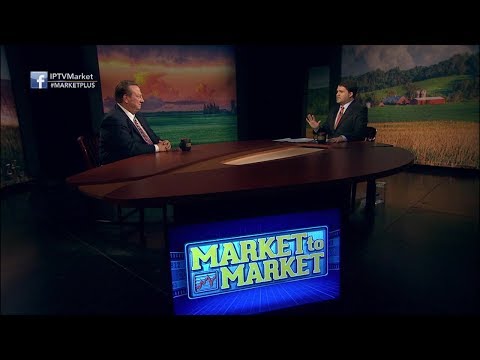
Joining us now, John Roach.
Hi, John.
Since we teased it at the end of the show I know
you've been extremely nervous about what I'm
about to pull.
But we want to give you a gift.
You came into the area after polar vortex had
left the area so we want to just make sure we went
and opened up this jar outside when it was 25
below.
That is cold air from the Midwest that you can take.
That is TSA approved with the Market to Market
stickers on it.
So you can take that at the end of the day.
Roach: Back to Florida.
Yeager: Back to Florida.
And if you think that's not enough we could go a
bigger version for you.
We also opened this up.
But if you're really worried, and I think you
are, that it's not truly going to be cold, we
filled our director Peter Tubbs' thermos for you.
This is insulated air so this should probably be
cold.
Do you miss cold weather when you see it on the
news when you're in Florida?
Roach: Not so much, not so much.
It is nice to come back to the Midwest and get a
little cold weather but it's really nice to get on
the plane to go back to Florida.
Yeager: Well, you are going to have a warm
weekend and this weather has been somewhat
impactful in the meat market, which we talked
about during the main program.
But people are already looking ahead to spring
and Mike in Mount Pleasant, Iowa is wanting
to know about spring nitrogen.
He has been watching fall nitrogen sales compared to
spring.
And he's wondering, is spring nitrogen rising in
price from fall?
Based on that, he says it's rising, would you
think more corn or more soybean acres are in store
for 2019 on that specific indicator?
Roach: Well, there's more than bigger demand that is
going on in the fertilizer business.
We're seeing some reductions in plant
capacities and so forth.
But what's driving the fertilizer market is more
corn expected, but it's not as much increase as
what the market would really like, or at least
the people that we talked to.
People still would like to stay in their rotations.
That has been proven to be the best strategy for
years and years.
So you really have to distort the price in order
to get people to move acreage and that's the job
of the market this spring, to put a bigger premium on
corn than beans so that for someone who is looking
at a field that they're trying to decide which way
do I go, the market wants you to plant corn, so
they'll need to move prices in order to get you
to do that.
Yeager: I'm going to ask a little bit of a government
shutdown question here.
Are you going to be more reliant on private
estimates versus government reports when it
comes to acres and planted and intentions and things
like that moving forward for the next six months as
we shake this out?
Roach: I don't think there's been that much of
an issue on future reports.
I think we missed some numbers, didn't receive
them, but we're catching up now or the government
is expecting to get caught up.
They're expecting to have the February 8th reports
out.
They're expecting, unless they've changed that in
the last couple of days.
Yeager: February 8th is the new January 11th, I
know that you've got that written down.
Roach: And then they're still anticipating having
their outlook session the latter part of February.
So the important reports are the ones that come in
March, the March 31 planting intentions report
will be very important, the stocks in all
positions report will be very important, to see
what intentions are obviously and then what do
we have in the bin and what has our usage rate
been?
Yeager: All right, I need a little strategy here,
and this kind of ties into our M-to-M podcast this
week that we had.
We were talking about ask the analysts.
This is one of those questions, John, where
it's a little more strategy.
And so, again, we're going to stick with Mike in
Mount Pleasant, Iowa.
Would it be prudent to hedge new crop soybeans at
these levels using a hedge to arrive?
So first, explain hedge to arrive and then this
question, if you would move forward with that.
Roach: There's two components to a cash price
on the farm.
One is the futures component and secondly the
basis, which is your connection to that futures
market.
Depending on where you're located you could have a
basis that is less than the futures, that would be
in the Western part of the belt.
In the Eastern part of the belt the basis actually
might be positive on top of the futures.
So those two components can be priced separately
and a hedge to arrive allows you to sell the
futures component and then wait on the basis.
In the soybean situation we're currently dealing
with a big carryover expectation for fall and
it's possible that can change and it's possible
that can start to become less burdensome.
But the problem right now is that we're going to
have a lot of beans and somebody is going to have
to hang onto them.
And so the basis is already discounted and
likely to stay discounted.
The only way to improve that situation is to quick
get a bin built and put the beans in a bin and try
to get basis improvement and carry all the way on
out into the summer of '20.
So I wish I had good news but when we have these
levels of surplus we're going to deal with poor
basis today for new crop delivery and likely poor
basis in the fall for new crop delivery.
Yeager: Well that kind of answers the next question.
Mike and Tony had one more and this was Mike again.
He's asking, is it likely that the soybean basis
will improve significantly if the trade tariffs with
China are resolved?
You didn't mention that in your last answer so that's
the only reason I want to bring it up.
Does China and the tariff have any impact on our
basis?
Roach: It has huge impact.
The reason that we have such poor basis levels is
because we don't have any business from China or
haven't had much business from China and so when we
don't see that demand then we don't get the demand at
the port and when we don't then it goes all the way
back into the interior.
But let me talk about the other part that you can do
something about.
You can set the futures for your new crop soybeans
and we did a lot of that this week.
We had a soybean sell signal and we sold into
the market both with old crop inventory and with
new.
We think we'll have another couple of soybean
sell signals between now and the summer and our
plan is to sell on both of them, both old and new
crop.
We're concerned that the bean inventory, unless the
Chinese really change and remove their tariffs
completely or something of that nature, we're going
to struggle to get out from underneath this big
inventory that we have in the bin today.
Yeager: And especially with the South American
crop that's just about ready to start coming into
the bins as well.
Roach: Exactly.
The South American crop, according to numbers we
saw this week, farmers there have already sold
about 35% of their crop and they're just in the
process of harvesting it, they've got about 15%
harvested or thereabouts.
So as they proceed with harvest it's hard for us
to get that business.
Prices seem to get discounted unless there's
a political decision that China will take our beans
in preference to Brazil's in which case them maybe
we'll fare better.
The key here is to realize these are political
decisions and although we wish we knew how they
would end we don't.
And until they do change we're still dealing with
tariffs there and we're still dealing with a
difficult situation.
Yeager: Do you remember another time when we had
politics influencing the ag markets as much as we
have?
Roach: Yeah I do actually.
I remember the last bean embargo that we put on -
so yes I remember more than one time.
One of the things that is really sad is that for a
lot of our trading partners the biggest
quantity of anything American they buy is
agriculture.
So whenever there's any kind of a trade issue that
goes on agriculture and farmers are the tip of the
spear.
And so that has always been the case and
unfortunately it's going to continue I think.
Yeager: All right.
Phil in Ontario, Canada, from Dresden up there, he
wants to know, you've got $10 in soybeans coming at
you.
He says, are $10 soybean futures a dream deferred
in 2019 if we can't get that trade deal?
So again, tied to China, what's your prognosis on
$10?
Roach: Well, if we don't get the Chinese tariff or
that trade situation relieved the inventories
that we're dealing with we're not going to see $10
probably.
There's one other wild card out here though,
actually two.
The Brazilian crop has been hurt with dry
conditions through most of its growing season and
that crop is still being reduced on kind of a
weekly basis.
And so that is possible that could change the
statistics certainly.
The other possibility is United States crop when we
put it in the ground we could have problems.
So that would be the second possibility.
And then of course the third is China.
So those are your three possibilities.
Right now we have China that is a plus and we have
Brazil that is a plus.
We could lose both of those pluses so be careful
and make sure you get some sales made in this price
area here.
This is a good price in view of the kind of
carryover that we currently have.
Yeager: So keep an eye out and as you say in your
newsletter, dribble things out so you're not stuck to
one piece of news.
All right.
Lexi wants to know, Lexi in Iowa, she's
@LexiFreund, and you can always follow us on
Twitter @MarketToMarket or IPTVMarket on Facebook.
With multiple government reports scheduled to come
out in the next two weeks, that would be before we
could have another shutdown, how will the
markets react?
Roach: We'll react to the reports.
If there are surprises, which some people think
there might be because there's so much space that
has gone by without much new information, then we
could react to that.
But I don't expect any shockers or surprise to
come.
If there is one to me it would be likely in corn
where we've used corn at a faster pace here than what
we thought we would and so we could actually get some
friendly numbers on corn.
Yeager: All right, last question of the ones that
are submitted and then I've got a couple of other
ones.
Dave wants to know, isn't it unusual to have a
soybean sell signal and a soybean meal buy signal at
the same time?
Roach: I thought that all week as I wrote about it,
particularly since the meal is the largest
component of a soybean's value.
It made me concerned about how far beans could go up
when their biggest source of value was going down or
unable to go up.
And so that is an unusual thing to have happen.
And you'll be happy to know that we no longer
have the sell signal in soybeans.
Unfortunately the meal had more pull down than the
beans had lift up.
Yeager: All right.
Crude oil, still north of $50.
We've held, now we closed at $55.28 today, up $1.59
on the week.
Is that market still headed that way?
Or what's driving oil?
Roach: Well, the economic news is just amazing.
The jobs report out today 304,000 new jobs in the
month, blew everybody away.
Yeager: Only 170,000 was the projected.
Roach: Exactly.
So big numbers, the news out on the earnings for
companies has helped rally the stock market and we've
also had the Fed come out and say we're not going to
raise interest rates here for a little bit.
So we really have a lot of positive news that kind of
hit in the equity market and of course that spills
over into the energy market rather quickly.
Yeager: All right.
And the dollar, we had a retreat from a 3 week low.
Usually when the dollar is lower that's better for
our products.
Are we going to go back to the low trend?
Or are we going higher on the dollar?
Roach: There's just so many things right now that
are up in the air here.
I think the dollar is in a state of flux.
We need to see what's going to happen with the
Chinese and this whole trade issue.
And we have a lot of things, irons in the fire
right now.
Yeager: It's not a broken record but it's a
legitimate story that is impacting a lot of
markets.
Roach: It really is and making traders very uneasy
because if the deal goes one way that's positive,
if it goes another way it's negative.
And so it's really a conundrum.
Yeager: All right.
Well, I know one conundrum, they just need
a little cold air and that will get them cooled off.
John Roach, thank you so very much.
Good to have you here.
Roach: Thanks, Paul.
Great to be here.
Yeager: That will do it for Market Plus.
And next week we will look at an East Coast industry
working to rake up new Midwest markets and Naomi
Blohm and Delaney Howell will sit at the table.
So until then, thanks for watching, listening or
reading.
I'm Paul Yeager.
Have a great week.


 For more infomation >> Plus belle la vie en avance : Sacha trompe Victoire, Ferri dans le collimateur de Leconte - Duration: 3:21.
  For more infomation >> Plus belle la vie en avance : Luna gifle Victoire ! - Duration: 1:16.
  For more infomation >> PlayStation Plus Free Games - February 2019 - Duration: 0:49.


 For more infomation >> Dev Vlog Sauver le Monde 01/02 - Signalement de joueurs, choix de héros et plus ! - Duration: 3:05.

Không có nhận xét nào:
Đăng nhận xét