Have you ever thought about how a robotic vehicle commonly used in military application
with bomb detention is controlled or how metal cutting
and forming machines provide precise motion for milling,
lathes and bending for metal fabrication
or how an antenna positioning system control the precision in azimuth and elevation?
As you will learn within this lesson,
servo motor applications are most commonly used in closed loop systems
where precise position control commonly found in industrial and commercial applications.
Together with the recently RealPars published video,
What is a Stepper Motor and How it Works,
and this lesson, you will learn about motion control using different types of motors available,
primarily stepper and servo motors.
Before we get into today's video, if you love our videos,
be sure to click the like button below,
and make sure to click subscribe and the bell to receive notifications of new RealPars videos.
This way you never miss another one!
In this lesson we will discuss what a servo motor is and how it works,
so let's first determine what a servo motor is
and examine some unique features of the types of a servo motor and its application.
Servo Motor Basics
Let's begin, with the servo motor basics.
Servo motors are part of a closed-loop system
and are comprised of several parts namely a control circuit,
servo motor, shaft, amplifier
and either an encoder or resolver.
A servo motor is a self-contained electrical device,
that rotate parts of a machine with high efficiency and with great precision.
The output shaft of this motor can be moved to a particular angle,
position and velocity that a regular motor does not have.
The Servo Motor utilizes a regular motor
and couples it with a sensor for positional feedback
the controller is the most important part of the Servo Motor
designed and used specifically for this purpose.
The servo motor is a closed-loop mechanism that incorporates positional feedback
in order to control the rotational or linear speed and position.
The motor is controlled with an electric signal, either analog or digital,
which determines the amount of movement
which represents the final command position for the shaft.
A type of encoder serves as a sensor providing speed and position feedback.
This circuitry is built right inside the motor housing
which usually is fitted with gear system.
Types of Servo Motors are classified into different types based on their application,
such as the AC servo motor, and DC servo motor.
There are three main considerations to evaluate servos motors,
first based on their current type - AC or DC,
and secondly on the type of Commutation used,
whether the motor uses brushes and the third type of consideration is the motors rotating field,
the rotor, whether the rotation is synchronous or asynchronous.
Let's discuss the first servo consideration.
AC or DC consideration is the most basic classification of a motor
based on the type of current it will use.
Looking at it from a performance standpoint,
the primary difference between AC and DC motors
is in the inherit ability to control speed.
With a DC motor, the speed is directly proportional
to the supply voltage with a constant load.
And in an AC motor, speed is determined by the frequency of the applied voltage
and the number of magnetic poles.
while both AC and DC motors are used in servo systems,
AC motors will withstand higher current
and are more commonly used in servo applications
such as with robots, in-line manufacturing
and other industrial applications where high repetitions
and high precision are required.
Brushed or brushless is the next step.
A DC Servo Motor is commutated mechanically with brushes,
using a commutator, or electronically without brushes.
Brushed motors are generally less expensive and simpler to operate,
while brushless designs are more reliable,
have higher efficiency, and are less noisy.
A commutator is a rotary electrical switch
that periodically reverses the current direction
between the rotor and the drive circuit.
It consists of a cylinder composed of multiple metal contact segments on the rotor.
Two or more electrical contacts called "brushes"
made of a soft conductive material such as carbon press against the commutator,
making a sliding contact with segments of the commutator as it rotates.
While the majority of motors used in servo systems are AC brushless designs,
brushed permanent magnet DC motors
are sometimes employed as servo motors
for their simplicity and low cost.
The most common type of brushed DC motor used
in servo applications is the permanent magnet DC motor.
Brushless DC motors replace the physical brushes
and commutator with an electronic means of achieving commutation,
typically through the use of Hall effect sensors or an encoder.
AC motors are generally brushless,
although there are some designs - such as the universal motor,
which can run on either AC or DC power,
that do have brushes and are mechanically commutated.
And the final classification to consider
is whether the servo motor application
will use a synchronous or asynchronous rotating field.
While DC motors are generally categorized as brushed or brushless,
AC motors are more often differentiated
by the speed of their rotating synchronous or asynchronous field.
If we recall from the AC-DC consideration,
that in an AC motor, speed is determined by the frequency of the supply voltage
and the number of magnetic poles.
This speed is referred to as the synchronous speed.
Therefore, in a synchronous motor,
the rotor rotates at the same speed
as the stator's rotating magnetic field.
However, in an asynchronous motor,
normally referred to as an induction motor,
the rotor rotates at a speed slower than the stator's rotating magnetic field.
However, the speed of an asynchronous motor
can be varied utilizing several control methods
such as changing the number of poles,
and changing the frequency just to name a couple.
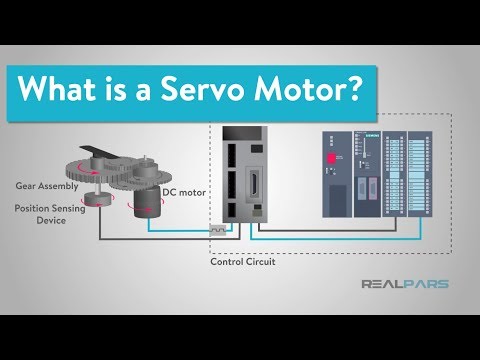
The working principles of a DC servo motor
are the construction of four major components,
a DC motor, a position sensing device, a gear assembly, and control circuit.
The desired speed of the DC motor is based on the voltage applied.
In order to control the motor speed,
a potentiometer produces a voltage
which is applied as one of the inputs to error amplifier.
In some circuits, a control pulse is used to produce DC reference voltage
corresponding to desired position or speed of the motor
and it is applied to a pulse width voltage converter.
The length of the pulse decides the voltage applied at the error amplifier
at the error amplifier as a desired voltage to produce the desired speed or position.
For digital control, a PLC or other motion controller
is used for generating the pulses in terms of duty cycles to produce more accurate control.
The feedback signal sensor is normally a potentiometer
that produces a voltage corresponding
to the absolute angle of the motor shaft through the gear mechanism.
Then the feedback voltage value is applied at the input of error comparator amplifier.
The amplifier compares the voltage generated from the current position
of the motor resulting from the potentiometer feedback
and to the desired position of the motor
producing an error either of a positive or negative voltage.
This error voltage is applied to the armature of the motor.
As the error increases so does the output voltage applied to the motor armature.
As long as error exists, the comparator amplifier,
amplifies the error voltage and correspondingly powers the armature.
The motor rotates until the error becomes zero.
If the error is negative, the armature voltage reverses
and hence the armature rotates in the opposite direction.
The working principles of an AC servo motors
are based on the construction with two distinct types of AC servo motors,
they are synchronous and asynchronous (induction).
The synchronous AC servo motor consist of stator and rotor.
The stator consists of a cylindrical frame and stator core.
The armature coil wound around the stator core
and the coil is connected to a lead wire through which current is provided to the motor.
The rotor consists of a permanent magnet
and this differs with the asynchronous induction type rotor
in that the current in the rotor is induced by electromagnetism
and therefore these types are called as brushless servo motors.
When the stator field is excited with voltage,
the rotor follows the rotating magnetic field of the stator
at the same speed or synchronized with the excited field of the stator,
and this is where the synchronous type is derived.
With this permanent magnet rotor,
no rotor current is required so when the stator field de energizes and stops, the rotor also stops.
These motors have higher efficiency due to the absence of rotor current.
When the position of rotor with respect to stator is required
an encoder is placed on the rotor and provides feedback to the servo motor controller.
The asynchronous or induction AC servo motor stator consists of stator core,
armature winding and lead wire
and the rotor consists of shaft and the rotor core winding.
Most induction motors contain a rotational element, the rotor or squirrel cage.
Only the stator winding is fed with an AC supply.
Alternating flux field is produced around the stator winding with the AC supply.
This alternating flux field revolves with synchronous speed.
The revolving flux is called a rotating magnetic field (RMF).
The relative speed between stator rotating magnetic field
and rotor conductors causes an induced electromagnetic force
in the rotor conductors according to Faraday's law of electromagnetic induction.
This is the same action that occurs in transformers.
Now, the induced current in rotor
will also produce an alternating flux field around itself.
This rotor flux lags behind the stator flux.
The rotor velocity is related between the rotating stator flux field
and the rotor rotates in the same direction as that of the stator flux.
The rotor does not succeed in catching up the stator flux speed
or not synchronized, hence where the type asynchronous is derived.
Servo Motor Applications are applied in many industrial and commercial systems
and products such as with robotics
where a servo motor is used at every "joint" of a robot
to perform its precise angle of movement.
The camera auto focus uses a servo motor built into the camera
that corrects precisely the position of lens
to sharpen the out-of-focus images.
And with antenna positioning systems
where servo motors are used for both the positioning of azimuth
and elevation axis of antennas and telescopes
such as those used by the National Radio Astronomy Observatory.
This concludes the video, what is a Servo Motor and How it Works.
I hope you have learned what's required to move forward
in creating your own motion control project.
If you enjoyed this video, please press the like button.
This video is one of a series of videos on motor
motion control, so please check back with us soon for more motion control topics.
Make sure that you head over to realpars.com.
To find even more training material for all of your PLC Programing needs.
We offer many videos to assist you in learning PLC Programing
and landing that job in a high-paying,
highly thought after field of automation and controls engineering.
Go to realpars.com and subscribe to our highly effective training series now!
 For more infomation >> What does motor neuron mean? - Duration: 0:41.
  For more infomation >> Wie Ersetzt man des Drehschiebers bzw. des Motor- Diverterventils einer Spülmaschine ? - Duration: 1:16.
  For more infomation >> Chế Tạo MOTOR Điện Từ Năng Lượng Mặt Trời ( how to make solar motor) ᴴᴰ - Duration: 3:50.

Không có nhận xét nào:
Đăng nhận xét