And now for something completely different
When hinges creak in doorless chambers, and strange and frightening sounds echo through
the halls.
Whenever candle lights flicker where the air is deathly still.
That is the time when ghosts are present.
Practicing their terror with ghoulish delight.
The Haunted Mansion is a beloved attraction found at Disney parks around the world.
The original version of the attraction opened on August 9, 1969 at Disneyland in Anaheim, California.
Now, lest you worry that I'm getting all Disney-nerd on you here and am ignoring the channel's
focus on technology--well I assure you we're talking about a very clever bit of engineering
that seems somewhat of an open secret and yet no one really talks about.
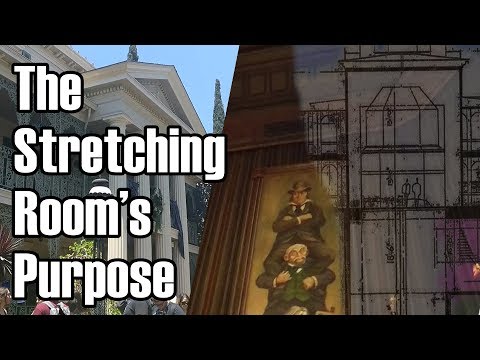
That, foolish mortals, is the stretching room.
All versions of the Haunted Mansion, except for Mystic Manor in Hong Kong, begin with
a pre-show in a portrait gallery.
GHOST HOST: [Our tour begins here in this gallery, where you see paintings of some of our guests as
they appeared in their corruptible, mortal state.]
This large octagonal room is lit dimly on all sides, and features 4 portraits.
After asking you to kindly step all the way in please to make room for everyone, our Ghost
Host reminds us that--
[there's no turning back now.]
As you look back towards the door you entered, you notice that it is closing.
And as soon as it's closed, our Ghost Host makes the following observation:
[Your cadaverous pallor betrays an aura of foreboding,
almost as though you sense a disquieting metamorphosis.]
As you look around the room, you notice that the ceiling is getting farther and farther
away from you, and the portraits themselves are growing taller, revealing the humorous
downfalls of their subjects.
GHOST HOST: [Is this haunted room actually stretching?]
Yes.
Yes it is.
And for very good reason.
The stretching room does not exist simply to serve as an intriguing pre-show to the ride.
Its original purpose is actually quite a bit more functional.
You see, the stretching rooms at Disneyland (there are actually 2 of them) aren't just
an illusion.
In fact, they are perhaps the world's most elaborate and unique elevators, or lifts.
Once the doors have closed, you may notice a very slight movement.
The stretching room floor is beginning to descend.
It moves very slowly which makes it hard to notice.
I'd say it feels like little more than a tremble in the floor.
The ceiling of the stretching room, on the other hand, does not move, instead you are
descending farther away from it.
But why does this need to happen?
Well, Disney has always had an obsession with sightlines and illusion.
When you are walking along the Rivers of America and see the Haunted Mansion, you see a quaint
antebellum structure that can't possibly contain the attraction itself.
If you're unfamiliar with the ride, it's an omnimover system where you travel through
many elaborate show scenes, including the massive graveyard scene.
There's no possible way that that attraction is in that little building,
and it's not.
All of the ride takes place in a separate show building on the other side of the railroad tracks.
The Disneyland Railroad sort of defines the boundaries of the park, at least the boundaries
of what guests are supposed to see.
It's built on a berm, and with the aid of trees and shrubbery, guests inside the park
generally cannot see anything outside of the railroad perimeter.
While great for immersion, the railroad sort of encapsulates the park and means that any
expansion must be done outside its boundaries.
If you look at satellite imagery of the park, you can see the mansion itself and the railroad
immediately behind it.
It's a little hard to see, but it is following this curved path through New Orleans Square,
behind the mansion, through Splash Mountain, and then you can see the tracks again here
in Critter Country.
You'll notice that the railroad slips between the mansion's facade and another building.
That large warehouse-like building is where the actual ride of the Haunted Mansion takes place.
Now when you're waiting in line, you have no idea that that building is even there.
You can even see the area behind the mansion, and as far as you know there's no connection
between the mansion facade and the show building out of view to the left.
Somehow you as a guest need to get from this side of the railroad to the other, and yet
there's no apparent path to take.
That's because the path you take is a tunnel heading under the railroad tracks and into
the show building.
Somehow guests need to be brought fairly far underground to the level of that tunnel.
One fairly seamless way to do so is to use an elevator and lower guests into the ground,
just like you would a casket.
But that might ruin the illusion that you're in the mansion itself.
And so the stretching room was born.
Now for those that hate it when someone spoils the magic, the following is my best guess
at how this effect is done in Anaheim.
There are some blueprints you can find online and there are some other explanations, and
what follows is my most complete amalgamation of these sources and my best understanding
of what's going on.
I may not be completely correct, and please chime in below if I've gotten something
wrong, but just know that I'll be spoiling this beloved scene.
When you enter the stretching room, pay close attention to the gap in the floor.
This is pretty much the only sign that you are boarding an elevator.
Once inside, well that's when things get weird.
The stretching room is simply a large, octagonal hydraulic elevator with a very elaborate cab.
The floor sits atop the piston of a hydraulic cylinder, and when fluid is released the floor descends.
The walls are stacked, sort of like a telescoping antenna, and are key to the illusion.
The stretching rooms at the Haunted Mansion are perhaps the only elevators in regular
passenger service that don't really have a ceiling.
The wood paneled walls that lie below the portraits are able to slip behind the upper
half of the stretching room.
The cornice that the gargoyles sit atop is attached to the wallpapered portion and hides
the gap between the two.
As the stretching room stretches, only the false ceiling is stationary.
Everything else is moving.
You yourself, in the bottom half of the stretching room, are descending at full speed.
The top half descends at only half speed, and as it does so it stretches the portraits.
The tops of the portraits remain next to the stationary ceiling, but the bottom is being
pulled down by the gargoyles.
Only when the portraits are fully extended do their tops pull away from the ceiling.
Having been transfixed by the illusion, you may not have noticed what our ghost host is
about to tell us:
[This chamber has no windows,
and no doors.
(sinister laughter)
Which offers you this chilling challenge; to find a way out!
(tormented cackling) ]
In perhaps the most grim, un-Disney like fashion, our Ghost Host informs us that his way out
of this chamber?
Well, exit by hanging.
[Of course, there's always my way.]
(Thunderclap)
The lights go out, and the ceiling (which is really a cloth scrim) disappears to reveal
the skeleton of our host dangling by a noose.
(Screaming, followed by a crashing noise)
That's right, it's the happiest place on Earth.
Anyway, that thunderclap is timed with the stopping of the elevator which again makes
it very hard to notice, and once the lights come back on, a second door opens revealing
the path to the ride.
It's at this point that you are in a tunnel walking under the railroad tracks.
What makes this illusion so disorienting and hard to nail down is the use of vertical stripes
in both the wallpaper and the wood paneling.
This is very effective at hiding the fact that the walls are moving.
The only really obvious thing is that the paintings are being unrolled as you can clearly
see the curve at the bottom.
But everything else is really, really difficult to grasp.
Unfortunately, the wallpaper tends to get damaged over time, but the upside is that
it reveals what's happening.
You can see that the walls are descending away from the ceiling because you have this
point you can focus on.
This also reveals that the portraits are on a separate piece that's not yet moving
--otherwise they wouldn't stretch--
but once they're extended, they too descend with the wall on
either side.
To hopefully help illustrate what's happening, I made this little mockup in tinkercad.
The yellow octagon is representing the stationary ceiling scrim.
Notice that the walls are both extended above the ceiling.
Now, unfortunately I can't make this move smoothly like it should, but I can move it
in steps.
You stand in the brown portion, and both it and the upper tan portion descend together,
but for every length you drop, the tan walls fall half as much.
The combination of an enclosed space, the vertical design elements, and the dim lighting
almost perfectly disguise the fact that you're only here because you need to descend into
the basement.
Now, it's very hard to see on video because, well, it's hard to convey scale this way,
but the stretching rooms at Disneyland stretch a TON.
The room becomes much, much taller, almost to a frightening degree.
That is after all kind of the goal, it disorients you, makes you feel small, and in general
is just sort of creepy.
By the time the stretching is done, you've descended almost 2 stories into the ground.
The blueprints I found, linked below, suggest the descent is a little over 18 feet.
A somewhat humorous side-effect of the scale involved here is that the doors to the chamber
are comically large.
The low light makes them near impossible to see on video, but the doors themselves are
probably around 15, maybe even 20 feet tall.
After all, they got almost 10 feet longer during the stretch.
Going back to our model, you can see that even the entry door must be as large as the
exit, even though the actual opening from the foyer is no larger than your average door.
What I love most about the stretching rooms is that they were born out of necessity.
The imagineers could have chosen any number of ways to get guests under the railroad tracks,
but they went with this.
And that my friends, I think, is just beyond cool.
The stretching room effect is so well liked that it was copied for future iterations of
the attraction.
However, except for the Phantom Manor at Disneyland Paris, the other versions of the stretching
room are not elevators.
Specifically at the Magic Kingdom in Orlando, the park was designed without space constraints
and the entire attraction is within the boundaries of the railroad.
There was no need to move guests underground, but the stretching room was still replicated.
In these versions, the ceiling simply moves up and away from you.
One unfortunate side-effect of going this route is that the scrim tends to visibly move
when the ceiling stops, which somewhat ruins the illusion.
And I'm pretty sure it doesn't stretch quite so much as the Disneyland version.
And now for some trivia.
I had a hunch that the stretching rooms at Disneyland may very well be the world's
largest passenger elevators.
To satisfy my curiosity, I googled "world's largest elevator", which is actually for
boats at the Three Gorges Dam in China, but I sad Passenger Elevator, and found that to
supposedly be in Japan.
This elevator carries 80 passengers and its floorspace is 11.15 feet by 9.2 feet.
That would give it an area of 102.58 square feet.
That seemed a lot smaller than the stretching rooms, and to assure myself I wasn't wrong,
I used my friend Google to find the area of an octagon with sides of 6 feet, which seemed
about right.
That would be 173 square feet!
That's much bigger.
But I wanted to find out how many people could fit, and thanks to the wonders of YouTube,
someone was able to ride the stretching room back up, and the cast member told them that
the elevator is only strong enough to bring 12 people up, but it can handle bringing 90
people down.
90 is bigger than 80, so ladies and gentlemen I do declare that the world's largest passenger
elevator by both size and capacity is not in Japan, but rather is at Disneyland.
At least when going down.
Apparently riding the stretching room back up isn't that out of the ordinary--guests
in wheelchairs often go this route to exit the attraction.
Although the attraction didn't open until 1969, after Walt Disney's death, the mansion
facade was built years earlier.
One source, linked below, says that the mansion itself was completed by 1964, and that the
stretching rooms were built with the facade.
The attraction was originally conceived as a walk-through attraction, and although Walt
Disney died in 1966, nearly three years before the attraction eventually opened, he may very
well have seen the stretching rooms.
However, other sources disagree, so we'll call that a firm maybe.
The really awesome link down below has pictures from 1964, showing the backside of the mansion
and the tunnels under the railroad.
I highly encourage poking around down there if you're interested.
And I'd like to leave the video by giving credit where credit is due for the existence
of this attraction.
There are lots of great links down below if you'd like to learn a little more about
the history of the Haunted Mansion, but specifically for the stretching room, we have Rolly Crump
to thank for its concept, Claude Coats for his woodworking skill, and Yale Gracey who
made the mechanics.
And the Ghost Host was voiced by the legendary Paul Frees.
Thanks for watching, I hope you enjoyed this look into the fascinating stretching rooms
of the Haunted Mansion.
A few months ago I made a different theme park-related video about blocking systems
in roller coasters, so if you haven't seen that and are looking for something else to
watch, look for it in the end screen.
Of course, thank you to everyone who supports this channel on Patreon!
Patrons of the channel have made a huge difference for the future of this channel, and starting
this week it's officially my full-time job.
Thank you for making that possible.
If you're interested in supporting the channel as well, please check out my Patreon page.
Thanks for your consideration, and I'll see you next time!
GHOST HOST: [Our tour begins here in this gallery, where you see paintings of some of our guests as
they appeared in their corruptible, mortal state.]
CAST MEMBER: [Ladies and Gentlemen please step away from the walls to the
dead center of the room.]
WOKE DUDE: Dead. Center.
 For more infomation >> Wow! So genoss TV-Star Stephanie Stumph "ihren eigenen" Super-Hit. - Duration: 2:47.
  For more infomation >> Schlager-Newcomer Ben Zucker: So geil war sein 1. Mal mit Helene Fischer. - Duration: 3:07.
  For more infomation >> would you be so kind? (No complete) - Duration: 0:11.
  For more infomation >> Kroos-Family im Stadion: So süß wurde WM-Toni angefeuert!! - Duration: 2:33.
  For more infomation >> Herzogin Meghan: Knallharter Ehevertrag – so streng geht der Hof mit ihr um - Duration: 7:33.
  For more infomation >> ur so gay, yifan. - Duration: 0:46.
  For more infomation >> Schlager-Newcomer Ben Zucker: So geil war sein 1. Mal mit Helene Fischer - Duration: 3:21.
  For more infomation >> Herzogin Meghan: So günstig kann ihr Brautkleid gekauft werden! - Duration: 3:37.
 For more infomation >> # Mc Bruninho SO AS NOVAS CONFIRA Música Nova 2018 Lançamento JULHO - Duration: 36:51.


 For more infomation >> SO BEDWARS DRAGONLARI BEKLEDİK.! - Duration: 3:42.
  For more infomation >> Wow! So genoss TV-Star Stephanie Stumph "ihren eigenen" Super-Hit - Duration: 3:00.


Không có nhận xét nào:
Đăng nhận xét